
What if someone told you that the average restaurant has more sophisticated technology requirements than most tech startups?
Sounds ridiculous, right?
A tech startup has some developers, some laptops, maybe some cloud servers. They're building one thing. One product. One focus.
But your restaurant? You're running point-of-sale systems. Inventory management across multiple suppliers. Real-time kitchen communication. Reservation platforms. Online ordering from six different apps. Staff scheduling. Customer databases. Payment processing. Security systems. Climate control. Music. WiFi for customers who will absolutely destroy you on Yelp if it doesn't work.
And all of this has to work together. Simultaneously. During a dinner rush. While someone's yelling about Table 12's gluten-free modification.
Yet somehow, we treat restaurant technology like an afterthought. And it services for restaurants — actual managed IT support — barely registers as a category most owners even think about.
The Friday Night from Hell (And Why It Keeps Happening)
Last month, a restaurant owner — let's call her Maria — was telling us about her Friday night disaster.
7 PM. Full dining room. Waitlist out the door. And her POS system just froze.
Maria's been in this business long enough. She knows the drill. She reboots. It comes back up. She gets back to the floor. Crisis managed.
But here's where it gets interesting. We asked her: "How often does this happen?"
"Maybe once a week? Sometimes more when it's really busy."
Once. A. Week.
"Have you called someone about this?"
"Yeah, I called the POS company. They said it's probably our internet. So I called the internet company. They said everything looks fine on their end. Maybe it's the POS."
Classic tech support runaround.
So we asked: "Who manages your network? Who looks at how all your systems work together?"
And she looked at us like we'd asked who manages the air in her restaurant.
"What do you mean, who manages it? It's just... there. It works. Mostly."
You're Not Running a Restaurant with Some Technology — You're Running a Technology Platform That Serves Food
Maria isn't alone. Most restaurant owners are in the same position.
Nobody told her that her restaurant is an incredibly complex technological ecosystem. The POS company sold her a POS. The reservation platform sold her reservations. The online ordering companies sold her delivery integration. The WiFi company sold her WiFi.
Everyone sold her a piece. Nobody sold her the whole picture.
So she's got this complex technological ecosystem and she's managing it the way you'd manage a toaster. Plug it in, hope it works, and if it doesn't, unplug it and plug it back in.
This is everywhere.
Your Restaurant's Tech Stack as a Human Body
Think of your restaurant's tech stack as a human body.
Your network is your nervous system. Every signal, every piece of information, flows through it. When it's healthy, everything works. When it's compromised, everything suffers.
Your POS, kitchen displays, and reservation system are your organs. They each have a job to do. But they don't work in isolation — they need to communicate with each other.
Your integrations — the way these systems talk to each other — are your circulatory system. Connecting everything.
And your data security, backup systems, and redundancy are your immune system. Protecting you from threats you can't even see.
Now here's the question: Would you trust your health to seventeen different doctors who never talk to each other? One doctor for your heart. Another for your lungs. Another for your liver. And when something goes wrong, they all point fingers at each other's specialties?
Of course not. That's insane.
But that's exactly how most restaurants manage their technology.
What IT Services for Restaurants Actually Means
The solution isn't what most people think. Most people think: "I need better technology." Better POS. Faster internet. Newer equipment.
But that's not the problem. The problem isn't the individual pieces. The problem is that nobody's looking at the whole system.
Nobody's asking: "How does all of this work together? What happens when this grows? Where are the vulnerabilities? What's the strategy?"
This is what IT services for restaurants actually means. Not "fix my printer." Not "reset my password." Strategic technology management for your entire operation, handled by techs who understand restaurant environments.
1. Network Infrastructure
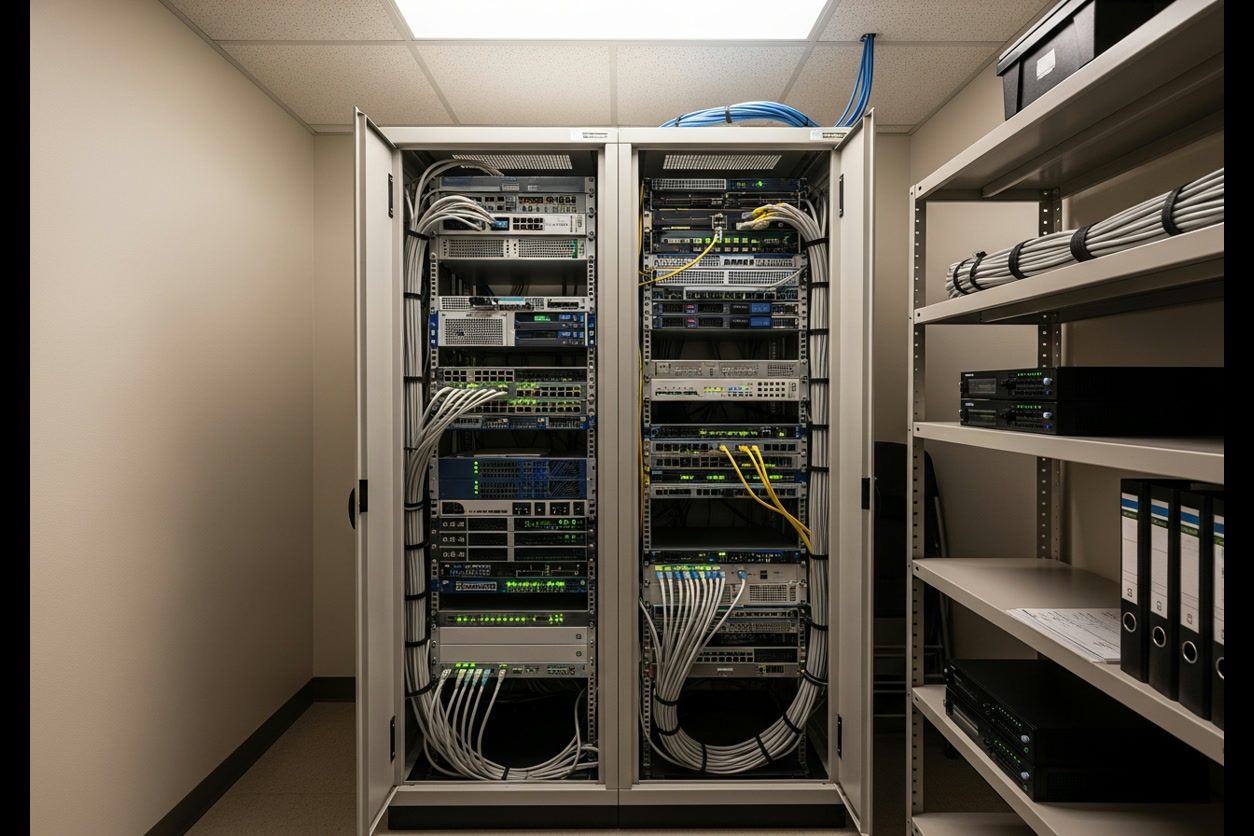
This is your foundation. Everything runs on your network — your POS, your cameras, your music, your thermostats, your WiFi for customers.
Most restaurants are running their entire business — their entire revenue stream — on a consumer-grade router from Best Buy. Maybe from 2015. With a password like "Restaurant123."
When that fails — not if, when — everything stops.
Managed IT services means enterprise-grade equipment. Redundancy. 24/7 monitoring. Someone who knows before you do when something's about to fail.
2. Cybersecurity
"Who's going to hack a restaurant?"
Here's the truth: you are the target.
You process credit cards. You store customer data. You run payroll. And you probably have almost zero security.
You're not too small to hack. You're the perfect size to hack. Low security, high value.
3. System Integration
This is where the magic happens — or where everything falls apart.
Your POS needs to talk to your inventory. Your online ordering needs to sync with your kitchen. Your reservation system needs to connect with your table management.
When these systems don't communicate, you get chaos. Orders that disappear. Inventory that's wrong. Double bookings. Revenue you can't track.
Proper integration means one cohesive ecosystem. Not a Frankenstein's monster of different platforms held together with hope.
4. Vendor Management
How many tech vendors do you have? Count them.
POS company. Internet provider. Online ordering platforms — probably multiple. Reservation system. Payment processor. WiFi. Security cameras. Maybe more.
Each one has their own contract. Their own billing. Their own support line where you wait on hold for forty-five minutes.
Who's managing all of that? Who's negotiating your contracts? Who's making sure you're not getting ripped off?
Most restaurant owners: "Uh... me? When I have time?" Which is never.
5. Strategic Planning
This is the one nobody thinks about.
Who's planning your technology roadmap? Who's thinking three steps ahead?
You want to open a second location next year. Will your current systems scale? Can they handle multiple locations?
You want to add a ghost kitchen. How does that integrate with your existing setup?
You're looking at a new kitchen display system. Will it work with your current POS?
If nobody's thinking about this, you're going to make expensive mistakes.
This Is What a Fractional CTO Actually Does
Most restaurants can't afford a full-time Chief Technology Officer. And that's fine.
But you need someone thinking like a CTO.
Someone who looks at your entire operation and asks: "What does this business actually need? Not what can I sell them — what do they need?"
Someone who saves you money through better negotiations, preventing downtime, avoiding redundant purchases.
Someone who keeps you focused on food and service and growth — not on whether your POS will survive brunch.
It's the same reason you have an accountant but not a full-time CFO. A lawyer but not a full-time general counsel.
You need the expertise. You don't need it sitting in your office 40 hours a week.
Two Pictures of a Friday Night
Picture One:
It's Friday night. 7 PM. Your POS freezes. Your server panics. You reboot. Customers wait. Kitchen backs up. You lose fifteen minutes of prime service time. This happens once a week. That's 52 times a year. How much revenue is that? How much stress?
You spend hours on tech support. You pay for redundant services. You make expensive mistakes. You lose sleep worrying about whether the system will hold up.
Picture Two:
It's Friday night. 7 PM. Your systems just work.
Your network is monitored. Your systems are integrated. Someone's already handling that thing that might become a problem next week — before you even know about it.
You have one number to call. One person who knows your setup. Real support when you need it.
You spend your time on your actual business. Your menu. Your team. Your customers. Your growth.
Which restaurant do you want to run?
The Cost of Doing Nothing
You think: "IT services? That's another expense. Another vendor to manage."
But you're already paying for IT. You're just paying for it in the worst possible way.
Through downtime. Lost revenue. Your own time. Overpaying for services. Making mistakes. Stress. Sleep you're not getting.
Good IT services don't cost money. They save money.
And more than that — they give you back your life.
You Didn't Get Into This Business to Be an IT Manager
You got into the restaurant business because you love food. Or hospitality. Or creating experiences. You had a vision.
Nobody's vision includes spending Saturday afternoon on hold with tech support.
The question isn't whether you need help with technology. You need it. Every restaurant does. The technology is too complex, too critical, too specialized.
The question is: Are you going to keep pretending you can handle this on top of everything else? Or are you going to treat your technology infrastructure like what it is — a critical business asset that deserves professional management?
You're a restaurant operator. You're not an IT director. And you shouldn't have to be both.
The next time your POS freezes at 7 PM on a Friday — and it will — ask yourself: Is this really how I want to spend my energy?
Because there's a better way. And it starts with one simple admission: "I need help with this."
That's not weakness. That's wisdom.
Ready to stop being your restaurant's IT department? Talk to Flyght.
Frequently Asked Questions
What are IT services for restaurants?
IT services for restaurants means professional management of your entire technology stack: network infrastructure, POS systems, cybersecurity, vendor relationships, system integrations, and strategic planning. It's not break-fix support. It's having someone who understands how all your restaurant technology works together and keeps it running so you can focus on running the restaurant.
How much do restaurant IT services cost?
Costs vary based on your operation's size and complexity, but most restaurants are already losing more to downtime, redundant subscriptions, and contract overcharges than managed IT would cost them. A fractional CTO or managed IT provider typically costs a fraction of what a single bad POS outage costs in lost revenue.
Do I really need IT services for a single-location restaurant?
Yes. A single-location restaurant typically runs 8-15 different technology systems: POS, payment processing, online ordering, reservations, WiFi, security, scheduling, and more. Each one has its own vendor, its own contract, and its own support line. Without someone looking at the whole picture, you're managing a complex technology ecosystem on top of running a restaurant.
What's the difference between a managed IT service and just calling tech support?
Tech support is reactive: something breaks, you call, you wait. Managed IT services are proactive: monitoring your systems 24/7, preventing problems before they happen, managing vendor relationships, and planning your technology roadmap. It's the difference between going to the emergency room every time something hurts and having a doctor who keeps you healthy.
What does a fractional CTO do for a restaurant?
A fractional CTO gives you C-level technology leadership without the full-time salary. They evaluate your entire tech stack, negotiate better vendor contracts, plan for growth (second locations, ghost kitchens, new systems), handle cybersecurity, and give you one number to call for every technology decision. Think of it as having a technology partner, not just a support line.

