
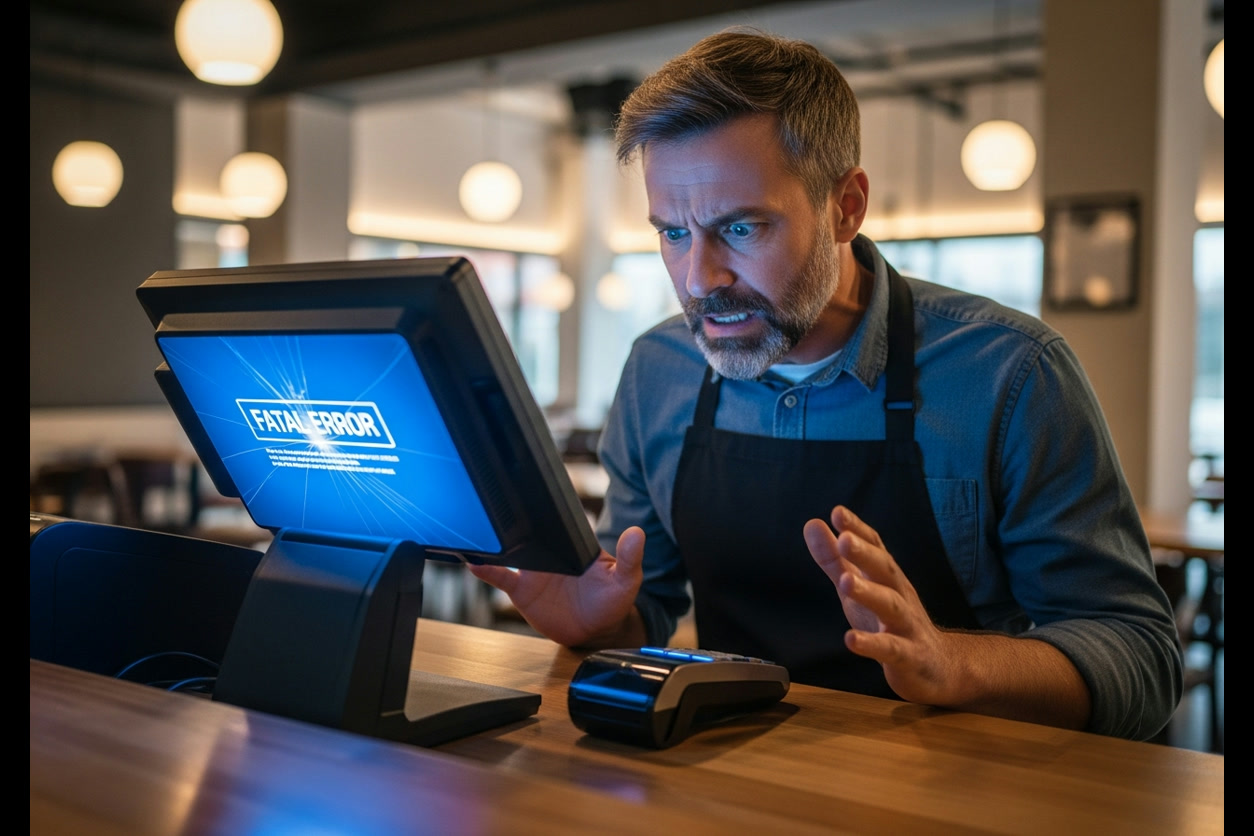
Three hours and nineteen minutes. That's how long one restaurant owner sat on hold with customer support on Christmas morning while his POS system was completely dead. The screenshot shows his phone timer — 03:19:32 — and by that point, he'd already been escalated three times, had a "team of people" supposedly working on his problem, and been told they were rebuilding his entire system from backup, which could take up to ten more hours.
Christmas morning. One of the biggest restaurant days of the year. And this guy is watching his revenue evaporate because he thought he was being smart by saving a few hundred dollars a month on his restaurant POS system cost.
Six hours later, they figured out his upstairs neighbor had gotten a new Panasonic smart TV for Christmas and connected it to his restaurant's POS network, screwing up the entire system. Six hours of lost Christmas revenue because his "affordable" system couldn't handle interference from a television.
The $45,000 Reality Check: What a Restaurant POS System Really Costs
Another owner in the same thread tracked his losses from a single POS failure: $45,000 in one week. Easter weekend, full dining room, packed bar, servers "absolutely panicking" as they tried to manually process everything.
Here's the math that should terrify you:
- Cheap vs. reliable POS difference: $300/month ($3,600/year)
- Single system failure cost: $45,000
- Years of "savings" wiped out: 12.5 years in one week
You're not saving money. You're gambling your monthly savings against losing 10-50 times that amount when your system inevitably crashes. That monthly fee isn't what your POS system really costs. The real number is what you lose when it fails.
The Staff Mutiny You Don't See Coming
What these threads reveal is something most owners miss: your staff is suffering every single shift, and they're not telling you the full truth. One server posted about getting anxiety attacks when anything unusual happens on their POS because the system is so unreliable. Another talked about how basic tasks like splitting checks take seven different steps when it should be one button.
Your best employees — the ones you can't afford to lose — are the first ones to get fed up with fighting broken technology. They know their worth, and they know other restaurants in town have systems that actually work. While you're congratulating yourself on saving money, your top performers are updating their LinkedIn profiles.
The turnover costs alone kill your "savings":
- Average cost to replace a restaurant employee: $3,000-5,000
- Training time for new hires on broken systems: 2x longer
- Productivity loss during turnover: Immeasurable
- Impact on team morale: Everyone else starts looking for exits
One restaurant owner switched from Micros to SpotOn to save money. Within months, every server had complained about the new system. The owner wrote: "Constantly having issues = nightmare during the rush. Left the place 6 months later due to better opportunity." Translation: the chef quit because of the POS system.
The Hidden Costs That Actually Kill You
Cheap POS systems don't fail quietly. They fail spectacularly, publicly, and always at the worst possible moment:
- During Christmas rush: Servers writing down credit card numbers (compliance nightmare)
- Peak dinner service: Customers walking out because payments won't process
- Weekend brunch: Five-star food getting one-star reviews because of payment disasters
- Valentine's Day: Perfect service ruined by system crashes
But the real hidden costs go deeper than you think. One owner described the workflow nightmare: "I get anxiety now if there is anything out of the ordinary I have to do for a table on this POS. It is NOT user friendly. Takes me twice as long to ring anything in." When basic operations cause anxiety, you're not running a restaurant — you're managing a crisis.
Your kitchen runs perfectly, your service is flawless, your food is incredible — but when customers can't pay their bills, they're not reviewing your amazing risotto. They're trashing your "disorganized management" and "unprofessional payment processing."
The Support Hell That Costs Everything
The customer support experience with cheap systems is uniformly terrible, and it gets worse when you need it most:
- "Nobody answers the phone support after 5pm"
- "Emails get answered 8-12 hours later"
- "I was on customer service for 7.5 hours while my restaurant sat empty"
- "They keep escalating me to people who are all 'stumped'"
One owner spent 7.5 hours on support calls during a system failure. Let's calculate that real cost: his hourly rate as an owner-operator ($50/hour minimum), plus lost revenue during downtime ($200-500/hour during peak), plus staff costs for people standing around ($150/hour), plus the customer experience disasters that create negative reviews for months.
That single support call cost him more than two years of the monthly difference between cheap and reliable systems. And here's the brutal part — it didn't even fix the problem permanently.
The Competitive Disadvantage That Kills Your Future
While you're dealing with system crashes, your competition is optimizing their operations. While your staff is fighting with seven-step processes for simple tasks, their team is focused on customer service. While you're on hold with support, they're analyzing sales data to improve their menu mix.
This isn't just about individual incidents. It's about the cumulative effect of running on inferior technology:
- Table turnover rate: 15-20% slower with unreliable systems
- Order accuracy: Higher error rates from complex workflows
- Staff efficiency: Constant workarounds drain productivity
- Customer experience: Every technical hiccup damages your reputation
- Growth capacity: Can't expand when basic operations are unstable
Your competition isn't just other restaurants. It's every business owner who was smart enough to invest in reliable tools from day one.
The Psychology of Bad Decisions
Here's why smart restaurant owners make this mistake: you're thinking like a cost center instead of thinking like a profit center. You see the monthly POS fee as an expense to minimize rather than an investment in your operational foundation.
But your POS system isn't a cost — it's the nervous system of your entire operation. Every transaction, every order, every customer interaction flows through this technology. When you cheap out on your nervous system, you're not saving money — you're creating systemic weaknesses that compound over time.
The Choice You're Actually Making
You think you're choosing between spending money and saving money. You're not.
You're choosing between:
- Option A: Pay a predictable monthly amount for reliability
- Option B: Gamble that money against massive, unpredictable losses during your busiest service
Every day you run on cheap systems, you're playing Russian roulette with your business. Most days you'll get lucky. But eventually, that chamber will have a bullet, and it'll fire during your biggest night of the year.
What Reliable Systems Actually Give You
Premium POS systems cost more because they include what cheap systems can't afford to provide:
- Redundant systems: Multiple backups prevent total failures
- 24/7 support: Real humans answer in minutes, not hours
- Offline capability: Keep running even during internet outages
- Professional setup: Proper network configuration prevents TV interference disasters
- Regular maintenance: Problems get caught before they become crises
- Integration ecosystem: Everything works together seamlessly
The monthly difference isn't paying for features — it's paying for the absence of disasters. Reliability has a price, and so does the lack of it.
The Bottom Line
The restaurants winning in your market figured this out already. While you're on hour six of customer support, they're serving customers. While you're explaining to customers why payments aren't working, your competition is providing seamless experiences that create regulars.
Stop gambling with your livelihood. Stop subsidizing POS companies' profit margins with your disasters.
The difference between cheap and reliable isn't $300/month. It's the difference between running a professional operation and crossing your fingers every day that today isn't the day everything falls apart.
Ready to stop gambling on your POS? Talk to Flyght about a system that actually works.
Frequently Asked Questions
How much does a restaurant POS system cost?
Restaurant POS systems range from $0/month (free tiers built on transaction fees) to $300+/month for full platforms. The price difference covers reliability, support quality, offline capability, and how well the system connects with everything else you run. But the monthly fee isn't the number that matters. A system failure during Christmas rush costs hundreds per hour in lost revenue alone.
What's the true cost of a cheap POS system?
Beyond the monthly fee, cheap POS systems cost restaurants through downtime (lost revenue during crashes), staff turnover (employees quit over frustrating technology), slower table turns, higher error rates, negative reviews from payment failures, and the owner's time spent on tech support instead of running the business. One owner documented $45,000 in losses from a single week of POS failure.
How do I know if my POS system is reliable enough?
Three quick tests: Does your system keep running when the internet goes down? Does support actually answer after 5 PM and on weekends? And how many steps does it take to split a check? Run those scenarios in your head. The answers usually tell you everything.
Should I switch POS systems if mine keeps crashing?
If your POS crashes regularly during service, the cost of switching is almost certainly lower than the cost of staying. Calculate your actual losses: revenue lost during each outage, staff time wasted on workarounds, negative reviews from payment failures, and your own hours on support calls. Add that up and compare it to what switching costs. The math usually isn't close.
What should I look for in a restaurant POS system?
Reliability first, features second. The non-negotiables: offline mode (keeps working when internet drops), support that actually answers after 5 PM, redundant backups, and pricing with no hidden fees. Beyond that, make sure it connects properly with your payment processor and online ordering setup. A system that works every time is worth more than one with fifty features that crashes during brunch.

